
Hello everyone, 2026 is here and I hope the first day or two has been peaceful. Inside my bible app yesterday, the verse was about, “I’m doing a new thing, can you not perceive it?”. I don’t recall the book/chapter but as we stare down another year and the successes or failures we know will come. My sincerest hope is we will see the new things God is doing in our lives!
That said, after completing the Signature Series – Vertical Spread Spreadsheet I began testing various vertical spread strategies. What I landed on was an adjustable vertical spread options strategy that maximizes potential return. In today’s post I’m going to share my thoughts about such a strategy. Let’s get into it.

Post Agenda
- Adjustable Vertical Spread Options Strategy Overview
- Strategy Construction
- Vertical Spread Example #1 – Favorable Price Move
- Vertical Spread Example #2 – Unfavorable Price Move
Adjustable Vertical Spread Options Strategy Overview
As we begin to unfold this dynamic vertical spread strategy its important to start with a look at the risks. First, vertical spreads are a defined risk strategy. We know from the outset of the trade what the maximum possible loss could be. Additionally, we know what the maximum possible gain could be. However, when we begin introducing adjustments it will be vitally important to keep a watchful eye on the risks, especially as they change.
Now, having said that the idea behind this adjustable vertical spread options strategy is to minimize risks as often as possible. Still, there will be instances, potentially often, where increasing risk is necessary to complete the strategy.
In a nutshell, the strategy begins with a simple ATM vertical spread of whatever width is preferred. Remember, by going closer to the money we actually limit our potential loss by accepting a larger credit. From there, we monitor the market for favorable price moves and adjust up the option chain to keep the spread ATM as price moves favorably.
Should price move against us, more risk will be introduced. Understandably, when price moves against a trade, “doubling down” isn’t usually the preferred approach. However, as I outline the trade further below hopefully that perspective will change.
In all, the strategy is designed to maximize the return of a simple vertical spread or at minimum achieve a positive outcome on a greater number of trades. Let’s look at setting up this strategy.
Strategy Construction
I began the last section with a focus on the risks of vertical spreads. They are defined, as we well know. However, for the adjustable vertical spread options strategy the risks will be dynamic and change as the position changes.
At the outset, I’ll open a vertical spread of any width I prefer. For me, I’ll start with $1 wide or potentially even $0.50 wide depending on the asset. I prefer that to say a $5 wide trade because as the trade progresses I may have to increase to a $5 wide spread.
Rather than describe the process let’s consider it in bullet format, step by step.
- $1 wide vertical spread
- Price moves favorably
- Roll up to ATM
- Keep width the same
- Price moves unfavorably
- Roll down to ATM or just OTM
- Option A – Keep width the same and increase number of contracts
- Option B – Widen the spread
- Option C – combination of both
- The adjustment should result in a net credit
That’s the entirety of the strategy in a nutshell. The most important consideration is to keep risk under a maximum level. For example, as I consider this strategy my maximum allocation to any one trade would be $500, a $5 wide spread, or 5 maximum contracts. The easiest way to look at this is like having a preferred allocation and then scaling in or out based on the market’s movements.
For instance, if I routinely enter $5 wide vertical spreads rather than go all in on the first trade I minimize risks and only go in with a $1 wide spread. If price continues in my favor I can gradually increase the profit potential. If price moves dramatically against the trade I’m accepting lesser risk, at least initially.
Once the trade begins moving against me I can roll down and simultaneously increase risk to save the trade. Up to my maximum allocation. If I didn’t have a maximum allocation then a fast moving market could create a catastrophic loss. However, in this approach I never take more than my accepted maximum loss and I have the ability to routinely increase my profit.
Over the long haul this will dramatically improve my P/L curve with lesser drawdowns and higher highs.
Vertical Spread Example #1 – Favorable Price Move
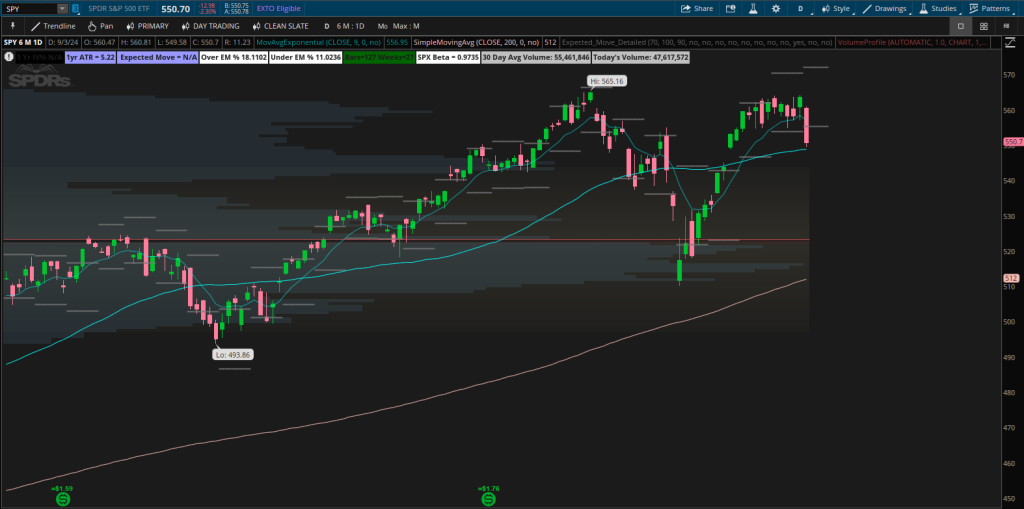
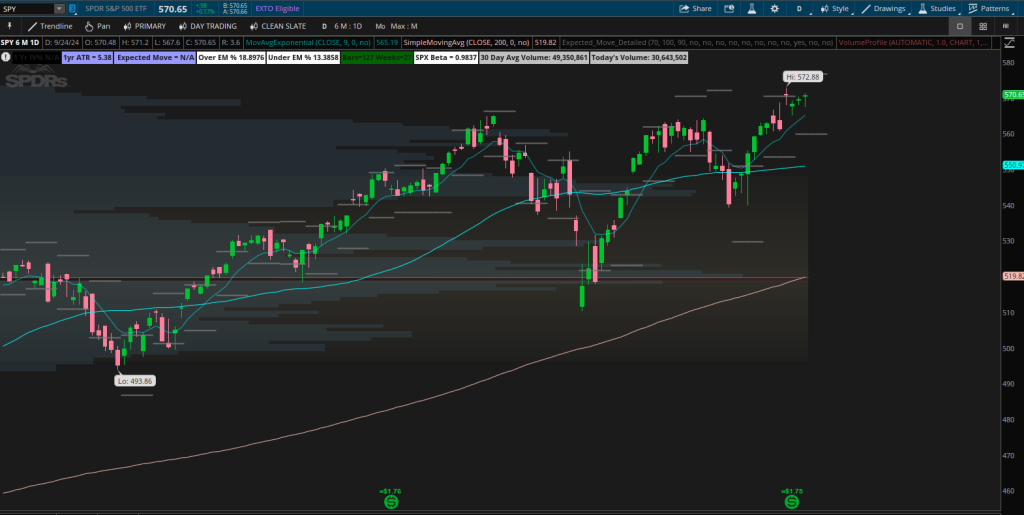
Suppose we looked at the chart below and saw this price action over the past 6 months. I think most would conclude the overall trend has been bullish with bouts of bearishness. With that knowledge, I’ll choose to implement a bull put spread to capture further upside potential.
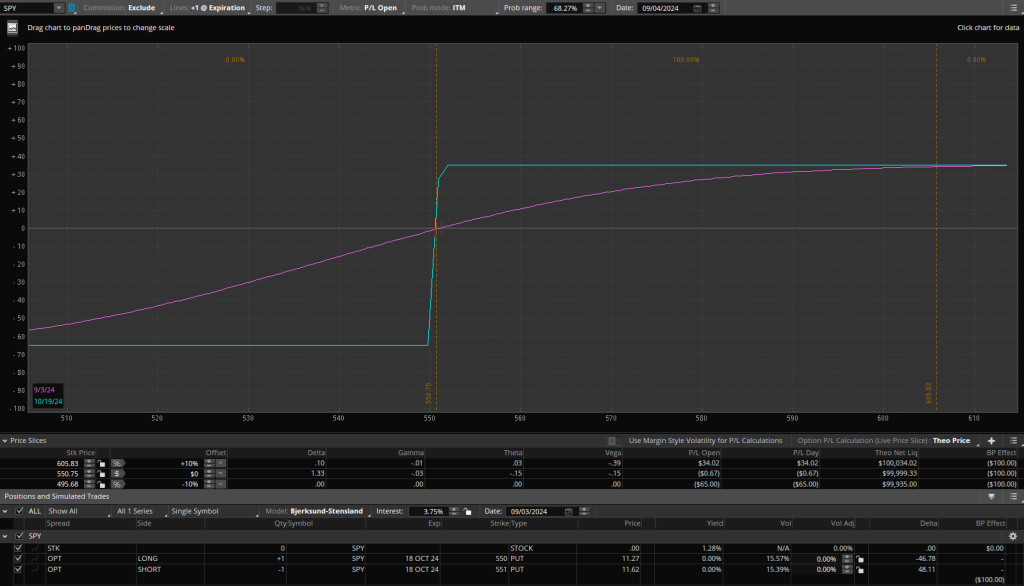
- Entry date – 9/3/24
- ATM Bull Put Spread $551/$550
- Credit – $35
- 45 DTE
Week 1
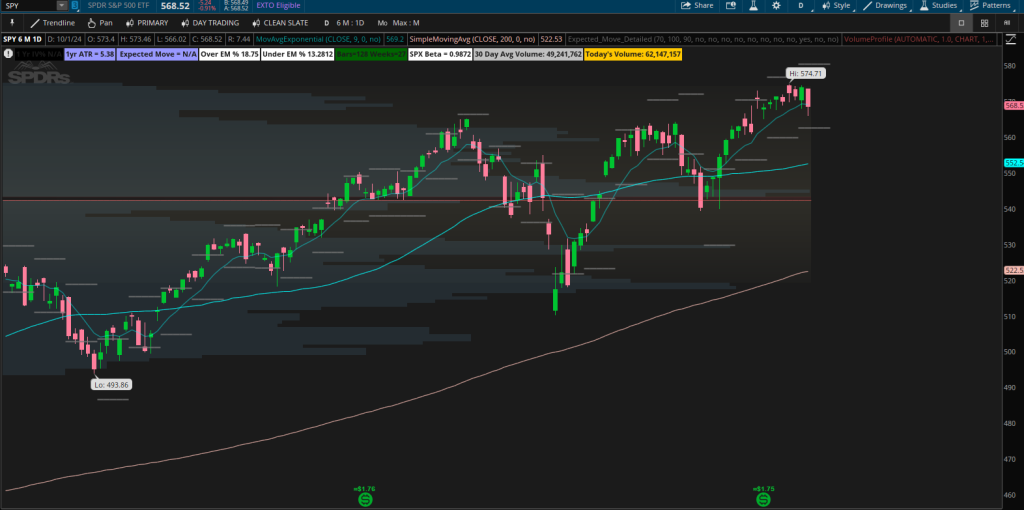
Now it’s important not to micromanage the position. Ideally, we’d like to only adjust after a favorable price move. After a week we see the below price move and the resulting impact to our position.

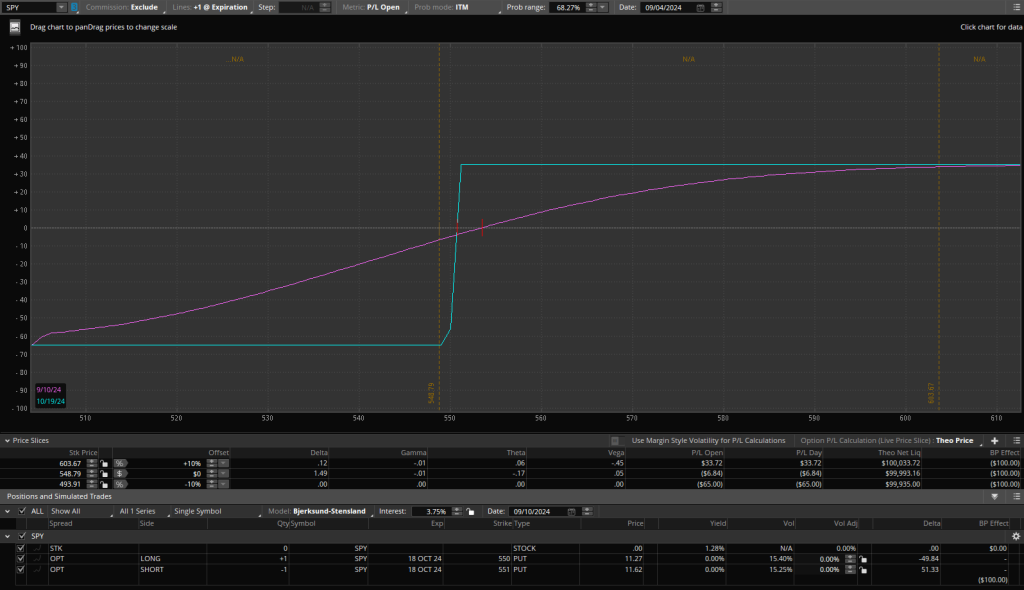
Price has moved against our trade this week but popped back in the last two days to make the loss very minimal. In this case, adjusting the trade or increasing risk doesn’t make sense. The trade is still very capable of turning profitable from its current position.
Week 2
After another week in the trade, price has moved dramatically in favor of the spread. At this point I’d want to adjust the trade to capitalize on further upside potential. Remember, at entry I accepted a $35 dollar credit. Now, I’ll aim to increase that amount by rolling the trade back to ATM. Lastly, as of today the trade has 31 days remaining until expiration. That isn’t important yet but can be as adjustments become required.

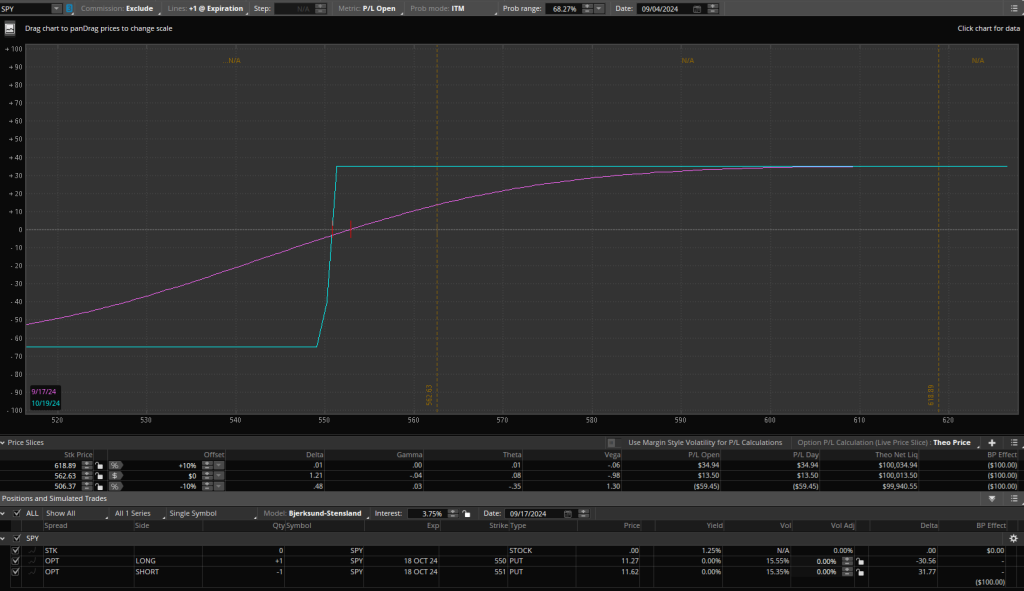
Naturally, we’d all love it if such a bullish move produced more in profit. In this instance, the sharp upward move only translated to a $13 profit. I could accept that and move on but I’m going to push the boundaries and attempt to maximize the profit potential even further. Here is the adjusted trade.
- Adjustment Date – 9/17/24
- ATM Bull Put Spread $562/$561
- Total Credit – $50
- 31 DTE
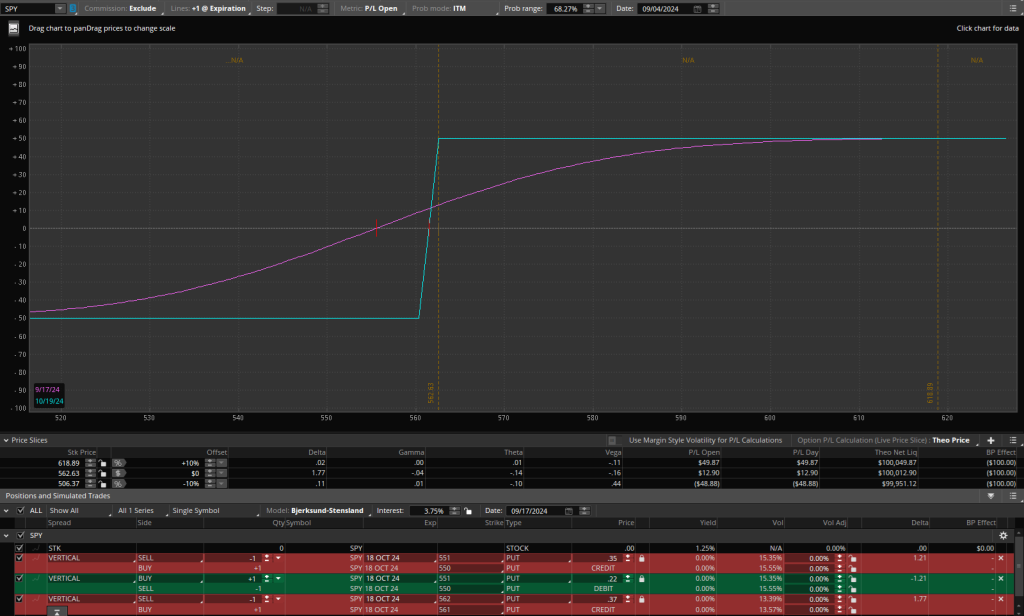
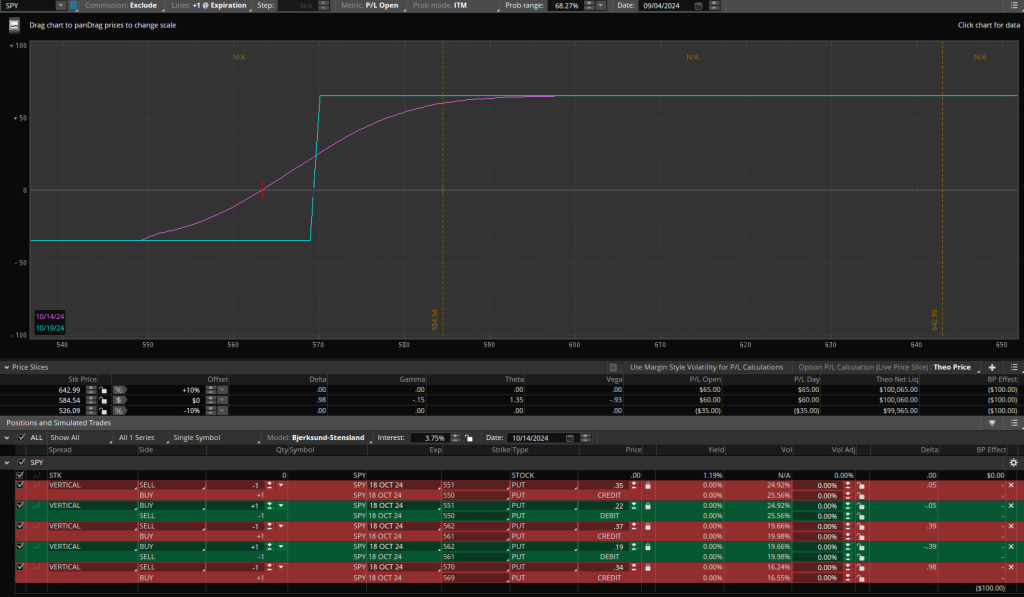
You’ll notice I’ve rolled the spread back to ATM to accept another $15 in credit. The trade has remained $1 wide so I’ve effectively made the trade 1:1 risk/reward. At most now I can only lose $50 versus the max loss before of $65.
Vertical Spread – Week 3
Week 3 was as I wanted with price inching higher and expiration drawing closer. 24 days remain in this trade.
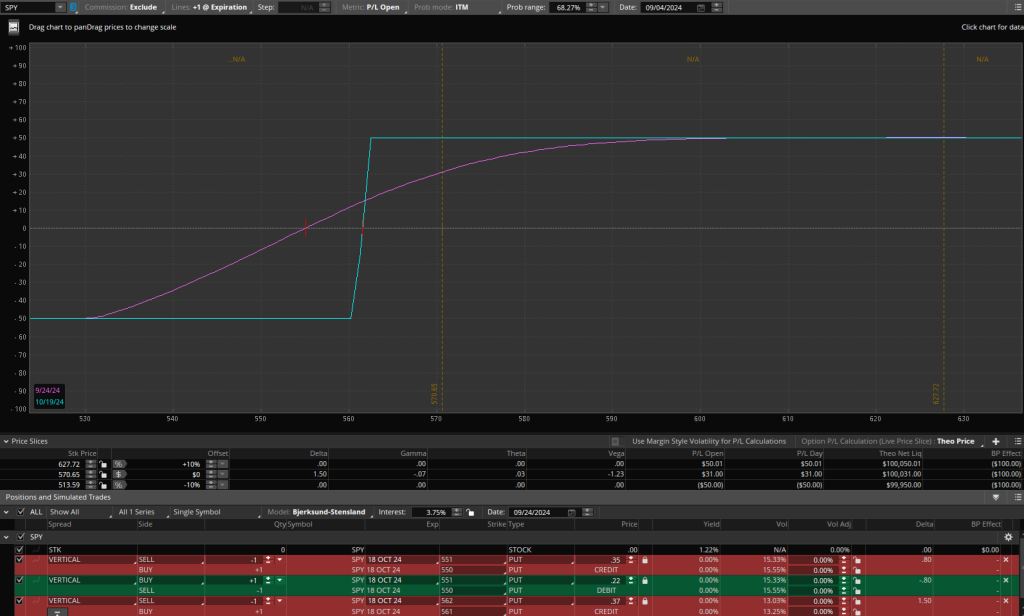
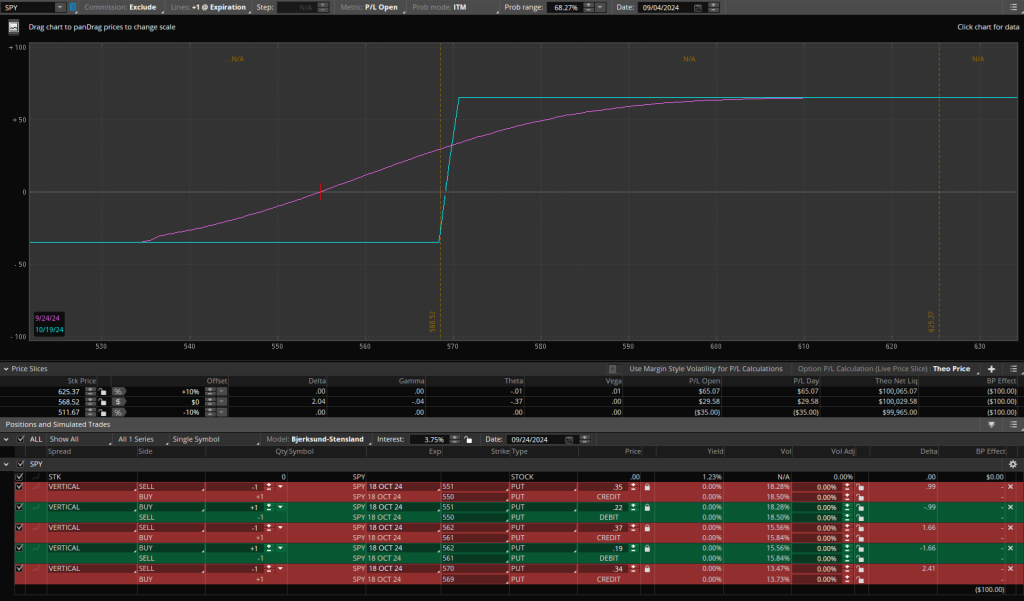
At this point we will again roll the trade up to ATM to collect a credit and minimize this risk even further.
- Adjustment Date – 9/24/24
- ATM Bull Put Spread $570/$569
- Total Credit – $65
- 24 DTE
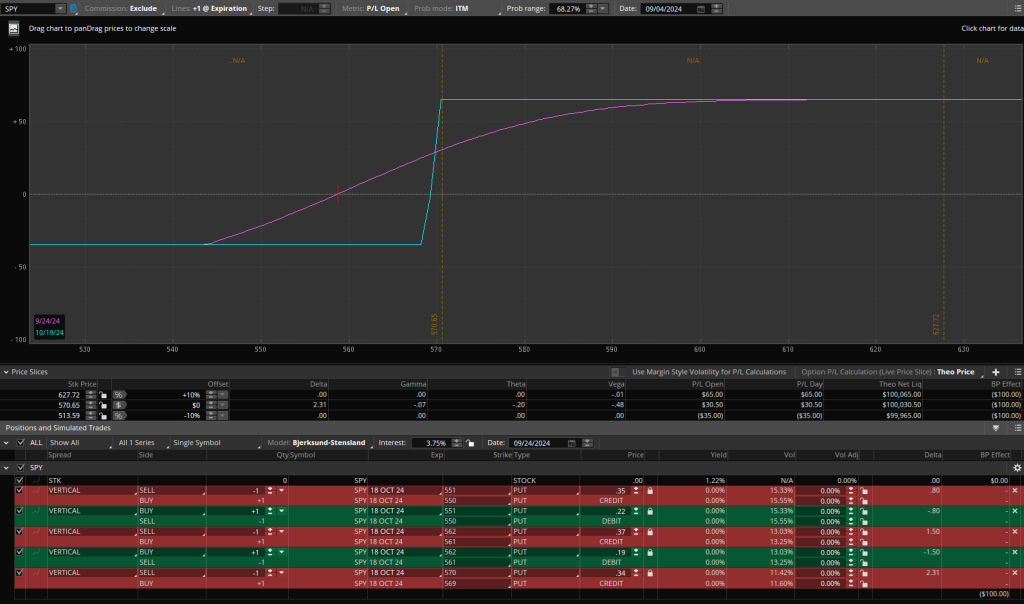
Vertical Spread – Week 4
This week, price moved against the trade. Not dramatically so the ideal path is to wait and watch price each day. If a favorable move results then simply closing the trade would be the best play. If another unfavorable move results I’ll more than likely need to adjust the trade. For now, I’ll wait and watch.
Week 5
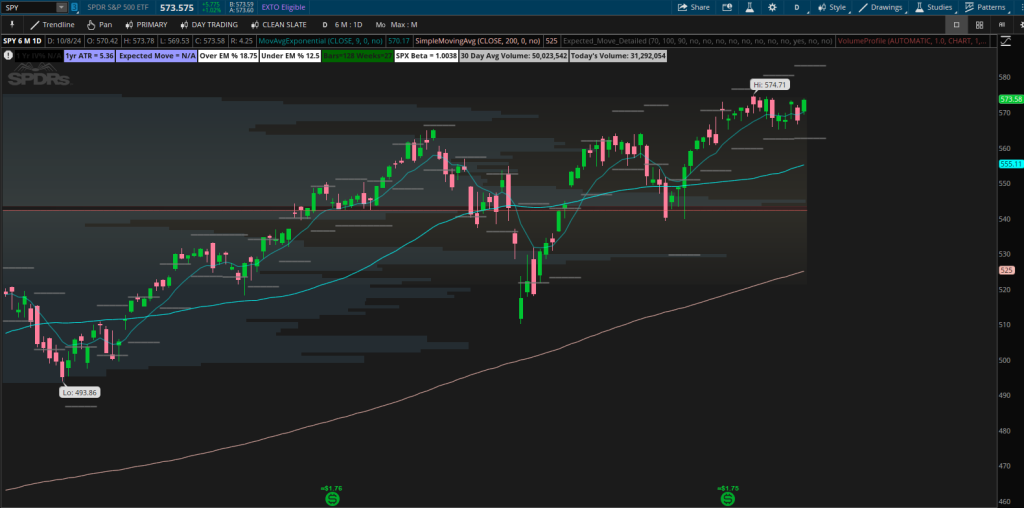
Nothing to report here, price moved around sideways before proceeding marginally higher. With only 10 DTE an adjustment wouldn’t make sense unless we were protecting a losing trade. In that instance, we could be adjusting the trade up to the very last day until expiration. In this case, just letting time fall away is the best possible option.

Vertical Spread Exit
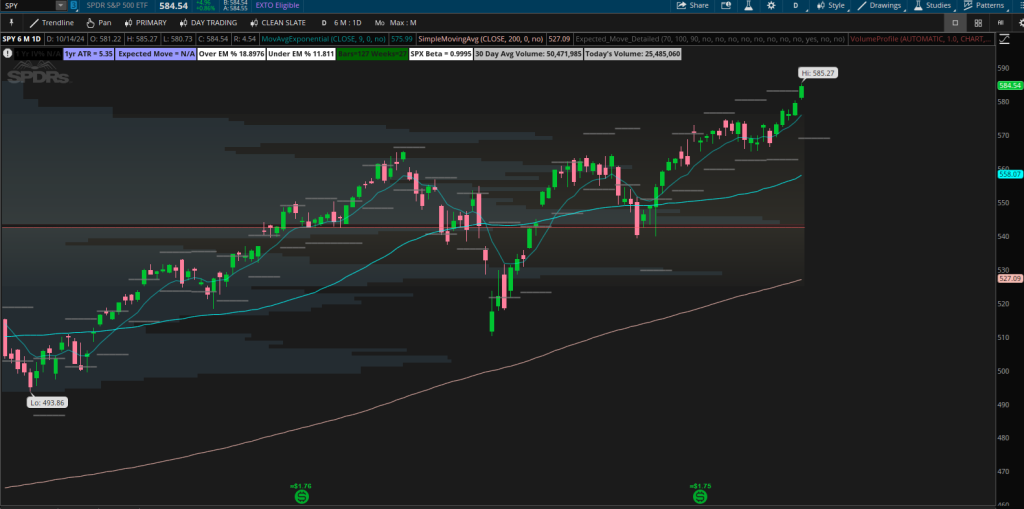
To close out the trade price took off fast to the upside and a near max profit was achieved. Still, this isn’t going to happen every time. I’d say 2 in every 5 trades may go this way. It’s the other 3 instances we need to be prepared for and in the next section I’ll share how to manage such a trade. For now, here’s how the trade closed.
Vertical Spread Example #2 – Unfavorable Price Move
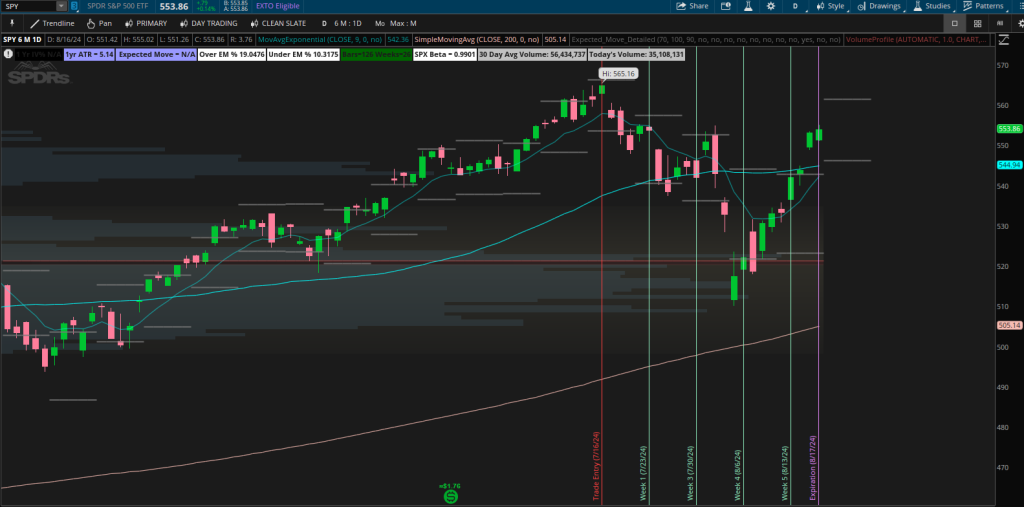
Rather than bore you to death with one image after another and to save me from so much additional work I’ll just show the price graph with annotations as the trade progressed. I’ll also include the analyze graph as well with all adjustments for you to review before discussing the trade.

Trade Discussion
Now, let’s talk through this trade. Initially I opened a $1 wide vertical spread for $40 but as you can see price moved against me immediately. At the week 1 mark you can see price had moved marginally lower. It wasn’t extreme bearishness but bearishness none the less. So, I had a decision to make. Do I adjust or let the trade play out? In this instance the down move hadn’t produced a significant p/l loss so adjusting the trade would only introduce additional risk.
It’s important, at least with this adjustable vertical spread options strategy, to let the trades play out. Especially the first trade. Very often price will fake one way before proceeding in the preferred direction. Thus, in this case, I let the trade move into the next week.
Week 3
By the third week I was convinced the price had moved lower and was staying lower than my original spread. So, I adjusted the trade to open another vertical spread ATM at $542/$541. This time increasing the number of contracts to two. This dramatically reduced my risk to reward possibility but did allow me to keep the trade going without accepting a permanent loss. Additionally, I’m ok with the unfavorable risk/reward for now because I’m going to increase that as the trade moves in my favor.
Lastly, by implementing only two contracts, I’m not throwing caution to the wind. Instead I’m inching into the uncertain price move with still far less than my maximum allocation while also improving the strike position.
Week 4
The following week brought about a significant downward move. This meant I needed to move up to my maximum risk allocation to salvage the trade. In a true bearish market with no price move higher I would have had to accept the maximum loss on this trade which would have been $451. Not great but considering most 10-15 delta vertical spreads have this level of risk/reward anyway it’s more than acceptable. So long as every single trade I take doesn’t finish this way the profits from winning trades will more than make up for it.
For now, I rolled the trade to ATM again at the $523/$522 strikes and increased to my maximum lot of 5 contracts. This allowed for a total profit potential of $49 and a max risk of $451. Not ideal I’ll confess but it’s important to remember that even the “high probability” trade initially would have had even worse risk/reward parameters.
Just for reference, the 10 delta vertical spread at entry on 7/16/24 would have a $30 dollar max profit and a $470 max loss. The 15 delta vertical at that time would have had the exact same risk to reward as our example here, a $50 max profit to a $450 max loss. Either one would have gone ITM and a large loss would have resulted with no option to adjust the trade without drastically increasing the risk.
Final Adjustment – Week 5
Fortunately as I entered into the maximum allocation price moved in my favor. I squeaked out a small profit but adjusted once more to lower the risk back down and increase the profit potential. Once I did the risk to reward looked considerably better. In that case I had a maximum profit of $87 with a max loss of $213.
I stayed with that trade into expiration and closed with an $84 dollar profit. In my opinion, this is a great trade in the face of a significant drawdown. From the day I entered the trade to the lowest price was nearly a 10% decline. This is fairly common as markets ebb and flow so having a strategy to salvage a losing trade is important.
Lastly, in this instance I made $84 dollars on a maximum risk of $451 at the largest adjustment. That means all together I realized a percentage return on risk of 18.6% in almost exactly one month.
Final thoughts
As I write this today I think it’s a tremendous strategy. The adjustable vertical spread options strategy isn’t how I or probably you have ever considered trading the strategy. However, if you think about it you’ll likely agree it’s an interesting proposition.
Still, I’ve yet to attempt the strategy myself. I will likely do something similar in the days ahead as I weight the possibilities. I like that winning trades have the ability to increase returns and I really like the ability to defend losing trades. By reframing how I view the vertical spread I’m able to continually put myself in a better position.
Finally, when looking at the second example trade above it’s important to remember a few key items. First, with every adjustment I’m moving my losing trade OTM. Second, with each week time is running out for the market to hurt me. Ideally, I wouldn’t ever have to reach my maximum allocation. If I do, inching in with an uptick in risk as price moves unfavorably makes way more sense than just diving into the deep end on day 1.
If you’re considering the vertical spread and don’t want a monthly charge to track the strategy. Please consider the Signature Series – Vertical Spread Spreadsheet. I think you’ll like what you find.
Until the next post.
God bless,
Jeff